


Larry Hodgson announced to his mother at the age of seven that he was going to be a glass blower when he grew up. Hodgson and his mother had visited Gatorland in Florida where they lived. He had watched a glass blower and had asked him, what Hodgson describes as hundreds of questions in the twenty minutes he watched.” He answered every one of them. I was so fascinated.”
His mother didn’t take his statement too seriously and according to Hodgson replied, “Yah and an astronaut and a firemen and a ballplayer. Sure you are.”
Hodgson started his career as an artist doing reverse paintings on glass. He met what is now his ex-wife at an art show and she was a glass blower. “I married into it.”
He worked with her for a few years and learned the basics, learning what you can and can’t do. “I learned the types of tools to use. Glass is pretty sensitive to what they call thermal shock. If you get things too hot, too quick it will crack. If you get things too big and you don’t keep them warm while you are working on them, they will crack. The glass we use is pyrex and it is pretty versatile. It can take pretty extreme temperature changes for the most part, so we can get away with a lot and that is why you can put that same glass in the oven and microwave and it won’t crack on you.”
After a time his ex-wife felt he was ready to tackle glass blowing on his own. “When I worked with her I was doing most of the grunt work for the first three years, doing the golding, painting the finish work, that type of stuff. It just got to the point where I was giving her technical advice while she was working she stated ‘You got it figured out, start making stuff.’ I gained a respect again because sitting down and doing it made me realize it only looks simple because you know what you are doing.”
The first piece Hodgson made was a little alien guy throwing a football. He explained the why of a little alien guy. “It didn’t come out looking anything like I was trying and it didn’t last the afternoon. It was riddled with flaws and it ended up breaking because there was so much stress in it. It made me want to understand it more because I knew I could sculpt it, but unless you do things proper through heating things the right way, they are not going to stay together. Mastering the art of glass work is a discipline you are always working on because the quicker you get with something, the less heat you are giving it, even a design you made 100 times. The quicker you do it, the more chances there are for failure.”
Hodgson and his ex-wife traveled to Minnesota from Florida every year for the Renaissance Festival in Shakopee. It got to the point that they couldn’t keep up with the demand during the week and they didn’t have a facility to make more during the fair. They settled in Minnesota Lake, as it was close enough to the fair that they could drive home and work during the week. Their studio had a storefront, but was more of a working studio. It didn’t have set hours for the public, but the locals knew if the lights were on, Renaissance Glass, the name of his business, was open.
In recent years Hodgson made the move to Wells and married Wells resident Diane Sonnek. He has moved his studio to the Northbridge Mall in Albert Lea and has set business hours. “When you are at home and look around all the things that need to be done, it is too easy to take the afternoon off. When at my studio, I am here and when I am not working that torch, I go crazy. It is a good motivator to keep me working.” Glass blowing is Hodgson’s full time career and he has spent 23 years at the Renaissance Festival and plans to continue that venue for many years into the future.
Hodgson explained his type of glasswork. “In a nutshell what I am doing here is actually referred to as glass lampwork.” Glass lampwork is a branch of glass blowing that gets the name from practices from days gone by. “In the old days they used to use an oil lamp. That was the heat source and they used to use a bellows to blow air over that flame to make it hot enough to melt the glass. People think with glass it’s always the big furnaces. We don’t use the big furnaces. We are heating up rods of glass with a torch. You can bend them and twist them into the figures.”
Most of the patterns from Hodgson’s glass creations come from his head by looking at pictures or designing his own. He described some of the challenges he has met in his work. “I like some pieces because of their end result. It looks super nice. I like other pieces because of the challenge and I also dislike those pieces for the same challenge. We had a carnival come through town in Minnesota Lake a few years back. They wanted something for the owner of the carnival. It was the 30th anniversary and this owner started out the shows with the Scrambler. They commissioned me to make a blown glass carnival ride. I’m thinking that’s a bunch of poles. I can measure them and make it happen. They let me climb all over the scrambler and I took a bunch of pictures for reference. I ended up making a blown glass scrambler that was pole for pole, a scaled replica of the Scrambler that they had been dragging around since the 50’s. This thing when it was finished was 28 inches across and 12 and ½ pounds. I gave myself a week to work on it, which I never do. I never do a week on a single piece. Seven days later I was still working on it. I was thinking ‘Oh my gosh, I bit off more than I can chew, never again.’ At the end of it, what I ended up with, was this giant blown glass Scrambler that I was really proud of, but I would never want to tackle it again.”
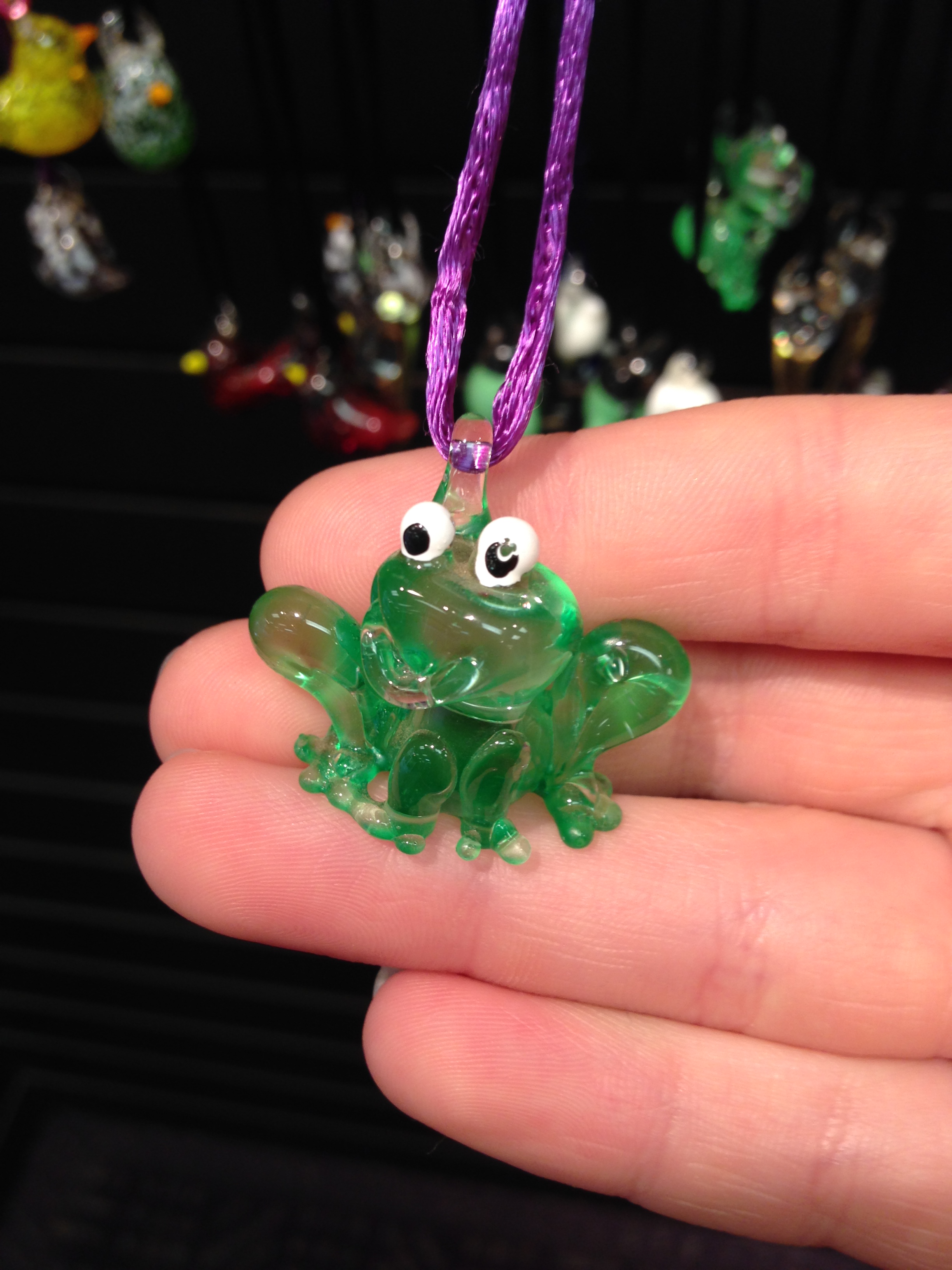
Hodgson’s studio has small, miniature pieces of glass made into animals, creatures and other delicate creations including necklaces and earrings. He challenges his customers to take a close look at the structure of the delicate glass pieces. If you look real close at blown glass you will notice most of the animals are just a teardrop. A teardrop of glass for the main body and then you add four legs. The tail dictates what the animal is. You must design so you always can hold on to that piece, still add detail to it and then usually any of that detail is brought out in the finish work when it is colder. Paint or gold is added and different things that bring the details to the surface.” Larger glass oil lamps with various blown glass figures also decorate the tables and walls of his store.
Hodgson uses very limited color glass as it is more expensive and a lot more temperamental to work with. The gold is put on when it is finished, then the gold is a liquid and painted on by hand. “The nice thing about the gold when you see a piece that has the gold you will know that it has been annealed” Anneal is a heat treatment that alters a material to deform under tension and stress and make it more workable. When the gold has to be fired on and it fires on at the same temperature that the glass anneals in, you know the glass has an extra process to help strengthen it.
Twenty years ago when Hodgson started in the business an 11 gram bottle of gold cost about $100. He had to call for the price, now that same bottle is over $400. Most of the glass he uses is from a company out of Colorado. It is all different size rods. There is a difference in companies and qualities and for some it is just the length of it.
Pyrex is a brand name. It is what Corning puts out and it’s actually a brand name for what is called borosilicate glass. When Hodgson started and pennies were tight, he would shop thrift stores and buy Pyrex baking dishes for pennies. The Pyrex would be put in a paper bag and busted up with a hammer. Then Hodgson would physically make rods with his torch. He explained, “In the early days, that worked great for the spun glass because you didn’t need the same kind of clarity for a solid piece. A person could get by, by doing that, but it is so much easier working with a clean polished rod that comes from a factory. If a person had to put gas in a bus to get down the road, this worked for a few extra dollars.”
There are not many people that make the statement that Larry Hodgson does about his career. “Is it the best job in the world? Absolutely! I lose such track of time working on the torch, that my wife Diane has to pull me back in. I need to say we are a perfect match. The way she plays with the children at the Renaissance Fair, my wife Diane is equally talented. they come back to see her. They ask for her. She does sales and she keeps everything easy going out there and makes sure everyone is having some fun. She has got the memory. She can remember the name of someone and the face, whereas I can’t even remember where they are from.
She can give me that little jab and tell me that is the person that got the little unicorn with the blue mane last year. We sold 300 unicorns and she can remember that. So I ask the customer. “How are you liking that unicorn?”
The Renaissance Festival is what Renaissance Glass prepares for all year long and you can understand the passion he feels for the festival when he describes his experiences with his customers that frequent his shop at the fair. “The Renaissance is a big deal for us. We work all year long to have inventory. It’s been going on now for over 40 years and people still come out to support that show in costume and raring to get that turkey leg and souvenir. It’s a different customer than what we get in the mall. I absolutely love it. It is nothing but fun. When I am not doing sales I am out hawking for the booth. You can stand out there and make fun of people, make fun of their clothes, make fun of their baldness, whatever, and they still come in the shop. I am out there with my little wooden sword and I have a five year old or a seven year old and they are going to defend their mom’s honor.”
“Everything can be fixed or repaired. Most people don’t realize that. Between kids, cats, gravity, save the pieces. Super glue doesn’t work, it says it does. What that means is that it will stick your fingers to it.
“If you have the opportunity to pursue your dream, pursue your dream. NO one’s going to be happy working in a job that they are not happy with.”
You can find Renaissance Glass at the Renaissance Fair or in the Northbridge Mall in Albert Lea, Minnesota.




 Sprinkled Notes