Have You Found Your Calling?

Depression is real. It is a hopeless feeling that wells up inside of you and takes over rational thought putting fears, doubt, and paranoia inside of you so that you want the pain to stop.

I know, for me, when I feel anxious, sad and overwhelmed, if I keep on the path of those feelings the endless depression will overwhelm me. Occasionally my remedy is going to bed for a day and confronting it. It is the only thing which starts me back on my journey to being able to smile and see the light.

I wasn’t feeling good this weekend and I tried to decipher if it was a real illness, meaning my stomach picked up a bug, or if my feelings of being overwhelmed with responsibility were the cause of my stomach and my tears of sadness.

I turned on meditation music and gave myself permission to wallow in bed. At first thoughts of all the things I needed to do kept churning in my mind. Did I really have to do any of them or was it my expectations that were stealing my peace? As I wandered through my life’s experiences and memories—I’m a firm believer in learning from your past to go forward to your future—I knew what was causing me to be on the edge when it came to expectations this time. I will save that for another time but what did hit me in this day of rest and meditation was the “calling.”

What was my calling? And was that part of my anxiety? We hear the question all the time from our churches, from the media, from friends and from strangers. Self-help gurus, some very good ones, promote all of us to find our calling. And our churches ask us continually “What has God called you to do?”

If I read the news first thing in the morning we have a constant bombardment from the news headlines and almost every headline has the word Trump in it, for or against. Almost every headline has a disaster in it.

My cell phone updates frequently warn about the winter storm warnings or the flood warnings. A plane crashed, kids are hungry and illegal immigrant children are being kept from their parents and mistreated. The Social Media tells us if you’re a Republican you are supposed to be upset or hate Democrats and if are a Democrat you are supposed to be against and hate Republicans.

We feel helpless in the midst of all of this chaos. So not only are we supposed to find our calling we are supposed to find it in the mess we are bombarded with everyday.

There are so many volunteers needed everywhere. I have friends that spend their lives giving and giving and giving. They are busy 24-7. Not only do these people spend their time volunteering, they also have to juggle taking care of their family and spending time with them in the midst of the good things they are doing. Have they found their calling? I often wonder about how they keep up, or do they have to make those difficult choices for society over family? I remember at times being too busy volunteering to have time to help someone in my family.

What about parents who have to run with their children, work a full time job, and still expect or are expected to be the ever present volunteer to make the world better for their kids. Have they found their calling?

I lay in my bed this past weekend pondering these questions. I do think too much. It is hard for me to just be. I pondered these questions because I felt guilty being down and depressed when so many others are spending their time helping others. How do they take care of themselves so they can give back to others?

I know we need to stop hunger, stop global warming, stop sex trafficking, stop gun violence, stop ignoring the elderly and their needs, feed the homeless and the list goes on and on and on. I know we need to raise a next generation that is respectful and responsible. These are all things I know. I read the headlines and the list seems impossible because inside all those headlines we aren’t given any good news.

I don’t know about you—these things bother me because I can’t do anything about any of it—but if I am called to do something as everyone tells me, what am I called to do? It seems when people preach or bellow about our calling they always want to make us think if we aren’t doing something out there for the world to see we are failing. We are drug down to believe rest or being busy is laziness and failure. We have to be on the move all the time. Is this what we are teaching our youngsters? Nothing we ever do is good enough in the eyes of the world.

My sister-in-law, who lived states away, years ago came to visit my mother-in-law who was in a nursing home. After visiting, my sister-in-law came to my home and told me I was called to bring my mother-in-law out of the nursing home into our home and take care of her. I felt guilty because I didn’t want to do that. Was that my call and I was ignoring it? That time I was at a good place in my life and I knew just because we had a responsibility we needed to do or had a responsibility that we could do, didn’t mean that was what I was called to do. We all do things because we need to do them. We all do things because we might be good at it. That doesn’t mean it is our calling. At least I at the time, didn’t feel like that was my calling.

As I took care of me on this lazy weekend day I felt guilty for taking the time to get it together. In reality, if someone would have asked me to do something for them that day I probably would have said yes and put my “me” day on hold. And it would have been because I have been programed to put myself second and so have many people.

The day did me good. I, in my head, know if I don’t take care of me, I can’t take care of anyone else. But yet…what is my calling? Should I feel guilty because I don’t know?

What if I said, after my day of rest that I do know what my calling is NOT. I am not called to make another person feel bad. I am not called to use my words in a way that will degenerate another living human being. I am not called to hate. I am not called to judge. I am not called to be cruel.

I don’t know what my calling is. I don’t know if I need one. If I stick to what I know I am not called to do, would that be enough? If all of us did that, would we need all the venues we need today to combat those things?

Perhaps our calling is the gift God gave us when he gave us our magnificent bodies and what we are called to do is to take care of them, and then the rest will all fall into place because we will be peaceful and whole.

Perhaps all we really are called to do is to love one another. Rather than being confused about all the material and societal mores to live up to, we could rest in our journey if we felt love from others, for others, and for ourselves. Wouldn’t the headlines be fun to read each morning? In spite of whatever is happening in our lives whether it showing others who we truly are, weathering storms, the personal and the weather related, love would get us through.

Immigration, has it changed since the 1900’s?

Sprinkled Notes published in the Albert Lea Tribune and the Courier Sentinel the week of September 17, 2018

by Julie Seedorf © September 2018

Alex Haley stated, “When you start about family and lineage and ancestry, you are talking about every person on earth.” Alex Haley was an American writer and the author of the 1976 book “Roots.”

Recent events in the news in southern Minnesota have caused me to ponder my ancestry.

My Grandma Julia immigrated to America in the late 1800s. She came from Poland when she was 18 or 19 years old. She did not have a job lined up for her — at least that I know of —  and entered the United States through Ellis Island.

How she made it to Minnesota and to later meet my Polish grandfather, I do not know. I do know he was quite a bit older than she. They settled on a small farm on what was then the edge of Wells. She raised six children. My Grandmother Julia never spoke a word of English. I do not know why Grandma Julia did not learn the English language.

My grandfather died in 1934. In 1934 my mother was 26 years old. She had two older brothers and three younger brothers. My non-English speaking grandmother was left alone in a country where she couldn’t speak their language. Her children had to help support her.

It wasn’t popular to be a polish immigrant back in the early 1900s. They had to form their own communities because they were not well accepted and they were called some not-so-nice names.

My mom, dad and I lived with my grandmother until I was in sixth grade. I never questioned it. It was just my normal life. And I didn’t question the fact that I couldn’t understand a word my grandmother spoke. I never knew what my mom and uncles were saying to my grandmother. And no one offered to teach me the language, and I didn’t pick up much of what they were saying except by their facial expressions. All of my uncles and my mom spoke English fluently because they grew up here but they also knew their native language. My dad also lived in that household and never knew a word of Polish.

When my Polish-speaking family met other Polish-speaking people, they reverted to the Polish language when speaking. Because I was used to it, it never bothered me. I actually never thought much about it at all until I got older.

One day in my middle adult years as I was working as an office manager, some non-English speaking people came in for help. Only one could speak English — at least that is what I guessed since they were the one doing the speaking, and then would translate to the others. I felt uncomfortable. The reason I felt uncomfortable was that I wasn’t sure if they were talking about me or making fun of the advice I gave. There was no reason to think that, but it was my own insecurity making those feelings comes to pass. And part of me felt fear because I was treading in an unknown situation.

I remember back in the ’60s visiting my family in California. When we were out and about there were many people living there that were not speaking English. They were all around us. My family wasn’t concerned and took it to be their normal.

Residents of many other countries learn many different languages, and they are fluent in more than one. How many of us can claim that? When many of us Americans are tourists and visit other countries many times we do not speak their language so it should come as no surprise that tourists from other countries can’t speak ours. However, many do.

After I thought about my family and read about the comments being made because of an incident with a southern Minnesota police officer — and I am in no way defending or commenting on his actions right or wrong — I concluded as much as our country has progressed in many things we are still experiencing the same things my family was experiencing back in the early 1900s when it comes to immigrants.

My immigrant Polish grandmother that could never speak English raised six children who went on to become carpenters owning their own construction businesses, including working for movie stars and building government projects, a school teacher and business owner, an owner of a locksmith business, a McDonnell Douglas employee building aircrafts and a farmer. From those offspring came two doctors, an accountant being a partner in one of the largest accounting firms in the country and more. Not too bad for the roots coming from a non-English speaking Polish Immigrant.

My point is that in the early 1900s people did not accept those Polish immigrants because they were different from what was perceived as being right in America. I felt comfortable with my non-English speaking family because their language was normal for me. I felt uncomfortable in my adult years by people who spoke a different language that I did not understand, which was outside my normal world, but those people, too, were immigrants. It was my fear of the unknown that was making me uncomfortable.

My grandmother became naturalized at some point but not until later in her life, and she still raised honest, hard-working, good citizens in her children even if she was not a citizen. The process to become an American citizen was much different back then.

I don’t know what the answer is. I only know I would not be here if it were not for my immigrant non-English speaking grandmother and grandfather. So why are we afraid? I’m not sure. Are you?

Happy Birthday Gladys Johanson – 100 Years Young

Something About Nothing by Julie Seedorf published the week of 10/23/2017 in the Albert Lea Tribune

“If you think in terms of a year, plant a seed; if in terms of 10 years, plant trees; if in terms of 100 years, teach the people.” — Confucius

I love this quote by Confucius. Confucius was a Chinese teacher, a politician, and philosopher that lived between 551 BC and 479 BC. This thought came to mind as I contemplated the people in my life who have reached the grand age of 100. I am awed by the fact I have an aunt that is going to be 101, an uncle who lived to be 102 and now I have a friend who celebrated her 100th birthday on Thursday.

File Oct 20, 9 26 32 AMMy friend’s name is Gladys Johanson and I first remember meeting Gladys back in my late high school years when one of her daughters was my best friend.
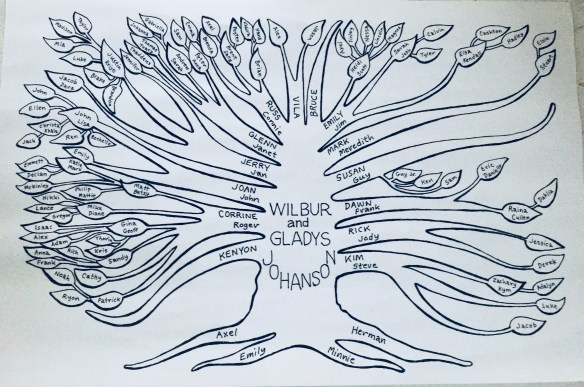
I want to share a little history on Gladys’ life. Gladys was born in Matawan on Oct. 19, 1917, and was the fifth child of Minnie and Herman Vogelsang. She had two brothers and two sisters and two brothers that died in infancy. She married Wilbur Johanson on Nov. 18, 1937. He passed away Nov. 29, 1975. She has lived in the same house since she married Wilbur.

One of the many amazing things about Gladys, at least to me, is the fact she has 14 children, having them all within 20 years. And of these 14 children, seven were boys and seven were girls. When I think of the stress we go through today raising one or two children, I can’t imagine raising 14. Yet, I always remember Gladys’ smile and her kind heart for everyone. Her smile today is as welcoming as it ever was. She has a happy glow surrounding her.

Gladys was a stay-at-home mom until later years when her final child was in school. She then entered the working world at Stamper’s factory, and she never missed a day of work in the 10 years she worked for them. I wonder how that happened with 14 children, even though at that point all were not still at home. We all know kids and germs go together and illness usually follows the adults in their life. How many of us now could say we haven’t missed a day of work in 10 years?

Here is another little tidbit I didn’t know. Not only did Gladys take care of her house and her children, she also was the bookkeeper for her husband’s carpentry business. Remember there were no computers back in those days, just brain work and the pen and pencil and maybe a typewriter.

I had the joy of sitting down with Gladys and her daughters Corrine, Kim and Dawn. I admit I had lots of questions because I was curious, not only on tips for aging but having been an only child myself, how it felt to be one of 14 children.

My experience in knowing some 100-year-old people has been that they didn’t seem like people that worried a lot. I asked Gladys about that. She answered, “I never worried, tomorrow was another day.” And, “When there is a will, there is a way.” As for being 100, she said she really didn’t feel any different than when she was younger. Her daughter Susan in an email told me as Gladys aged and started to discover things she could no longer do she would announce with a chuckle, “Well, I guess I can’t do that anymore.”

One of the things Gladys and her children attribute to longevity is a healthy diet. The backyard was a garden, and Gladys and her husband raised the food for their family. The gardening became an assembly line and even the smallest child was put to work doing something. Canning was a big part of their life in having their homegrown food year round.

According to Gladys daughters, each child had their own job. Saturdays were cleaning day and you did not go anywhere until the chores were done. And if you are a teenager out there today reading this column — the kids in this family had to earn money and put their own gas in the car if they wanted to drive.

Gladys is a fabulous cook and the girls shared one of their favorite dishes was their mother’s mashed potatoes. Corrine stated, “It must have been the love she put into it.”

Supper was always served at 6 p.m., and family members were expected to be at the table at that time. “When you heard the whistle blow you knew it was time to be in for supper,” Corrine reminisced. “The table was always set correctly and she still does that today.” The Johansons had different sets of dishes for every day than for special occasions. And prayers always did, and still do, accompany Gladys’ meals. Faith is an important staple in her life. The prayer at dinner: Abba Lieber Vater from her German roots.

At 100 years old, Gladys’ eyesight is still stellar and she can read the tiniest print. Her spelling and penmanship today are perfect.

Sitting down again after all these years at the Johanson table, I still felt the comfort of being a part of the atmosphere. I felt the love this family has for one another with Gladys being the role model for generations of Johansons. These parents had the secret we are all looking for in raising our children, and it was summed up by a statement from one of the daughters: “We had discipline but we always felt showered with love.”

Gladys has 20 grandsons, 11 granddaughters, 21 great-grandsons, 19 great-granddaughters and three great-great-grandsons. And she has made a quilt for each one.

After spending time with Gladys, I realize she led a simple, hardworking, content life knowing what was important and what wasn’t, and she is reaping the rewards of a long life with a family that loves her. Isn’t that what we all want but forget when we are caught up in the world we live in today? Gladys is a role model for all of us.

I would say Confucius statement fits perfectly with this family. Gladys planted a seed, the trees grew and those trees blossomed and planted new seeds for generations to come. Happy 100th birthday, Gladys.


Gladys Wilhelmina Irene Vogelsang Johanson

Born in Matawan, MN on October 19, 1917. The fifth child of Minnie and Herman Vogelsang. She had two brothers: Melvin and Milton, and two sisters Mabel Buelow and Ellen Meyer. Two of her brothers died in infancy, Elroy and Roger.

She married Wilbur Johanson on November 18, 19367. He passed away November 29, 1975. She has lived in the same house since she married Wilbur.

She gave birth to 14 children within twenty years: 7 sons and 7 daughters:

Kenyon Johanson

Corrine Schultz

Joan Kuntz

Jerald Johanson

Glenn Johanson

Russell Johanson

Vila Stump

Bruce Johanson

Emily Ness

Mark Johanson

Susan Johanson

Dawn Dutton

Richard Johanson

Kimberly Zimmer

Mom and dad planted a very large vegetable garden in the backyard more out of a necessity than a hobby, and from the harvest, they canned and froze food for the upcoming winter. In later years, mother worked at Stampers factory for 10 years in Wells – never missing a day of work!  Mother also worked for her husband Wilbur as the bookkeeper for his carpentry business in Wells. Her hobbies were sewing and for her 30 grandchildren she hand-quilted each of them a quilt. Embroidery also became her hobby, and she hand-embroidered tablecloths, many dish towels and pillow cases for her family. To this day, she still embroiders.

Mother never complains she takes life in stride; often you will see her sporting a big smile. As she aged and started to discover things that she could no longer do she would announce with a chuckle, “Well, I guess I can’t do that anymore.”

File Oct 23, 10 15 55 AM