Do I Wail or Whine About Empty Nest Syndrome?

Something About Nothing by Julie Seedorf published the week of June 16, 2014 in http://www.albertleatribune.com and the Courier Sentinel

Whining and wailing were the words that were the topic of a discussion recently on a Facebook page of writers. We were all listing our pet peeves about writing and the words that are over used in books.

For instance, I have a habit of writing the way I talk. I say “so” and “that” often and other words I use that do not contribute to the story and bog it down with extra words. Thank goodness for editors that — I mean, who — occasionally take me to task for adding those words.

This day the discussion centered around books where people used the word “wailed,” which means to make a mournful cry or a high-pitched noise. The other word in the discussion was whining, used in books to describe a character or what the character is saying. There are characters that whine through the entire book.

As I was taking part in this discussion I realized I have been whining quite a bit lately. I have been whining about wanting to move closer to my children who are the parents of my grandchildren. I have been whining about being closer to a coffeehouse so I do not have to drive 20 miles to have my latte and pull out my computer to write. There is something about coffeehouses that sparks the creativity in me.

I have thought that my whining was actually about living in a bigger city. After spending a busy weekend with my family, and in a bigger community, I realized that perhaps my whining was more about still suffering from empty-nest syndrome. That realization was a surprise to me since I haven’t had any children in that nest for at least 15 years.

I have settled into a routine: Watch my own television programs, hibernate in the winter and do the normal everyday things. What I have come to realize is that if I don’t have frequent contact with people younger than me, I get more set in my ways and I feel older. If I don’t physically engage in conversation with young minds, my world doesn’t expand as much. There is so much to be learned from the youth of today.

It seems that if there are no young people in my home, it is easier to not take part in the youth activities in my community. If I don’t have a connection with a young person, then even though I may go to those activities, I am still a bystander. Where there is no encouragement to take part it is easier to settle into a shuttered life.

Visiting the city I also recognize the opportunities there are for older people. You can get lost in a big city, too, but there are also senior community groups such as the one at the Chaska Community Center that are active daily, have weekly activities and trips long and short each week.

The seniors have their own part of the building and daily there is something happening for older adults to get out and socialize with others of their age and also with the younger people in and about the community center.

I like being part of a small close-knit community where neighbors help neighbors. That is the richness of living in a small town. If I walk out my door I can guarantee that no matter where I go in my community I will meet someone I know. I like the quietness of a small town and I can wallow in that quietness, perhaps too much.

So I have been whining, caught between the richness of my community, and a place where I have lived most of my life, and wanting to expand my world to try the big city and all it offers.

Family is a big part of that exploring the big city feeling for me. It is about empty-nest syndrome and missing watching my children’s plays and basketball games. I am missing the daily rush to get done with supper and get the kids where they need to be for their schedules. It is missing what I learned each day from my children. It is missing the cute stuff they say and the laughter of having a family in the house.

Those of us who have children have all went through it. I can’t imagine I am the only mom who is the age I am and still missing the daily grind with kids. Perhaps it is about remembering my youth and the family that I was surrounded by, aunts, uncles, cousins and missing that connection, too.

Do I wallow and whine and wail or do I accept where I am placed? Do I, or I should say we, the other half of the empty-nest syndrome person, spread our wings and move closer to our kids and grandkids so we can enjoy the hustle and bustle of their sports, their music, their young lives?

I have to think, like the dialogue in a book, that my whining and wailing is getting repetitive. Is it time to edit the dialogue of my life?

Living An Ordinary Life? Never.

Archie Baumann was born in a log cabin in Bagley, Minnesota in Clearwater County. You might ask Archie Baumann? Who is Archie Baumann?archie and vi
Archie Baumann is one of those people who has lived an ordinary life. He is one of those people who normally doesn’t make the newspaper, but there is a story in every life, and this is Archie Baumann’s story.
Baumann grew up in Bagley, Minnesota. His mother died when he was five years old and his grandfather lost the family farm in 1936. Times were hard. Archie didn’t go to high school. He went to CCC Camps which stand for Civilian Conservation Corp.
Civilian Conservation Corps began March 31, 1933 and was particularly active in Minnesota. Men 18 – 25 years old could enlist in CCC Camps and work in a military style environmental camp. Enlistees were paid $30 a month to build roads, plant trees, hang telephone line and learn vital job skills.
According to Baumann $25.00 went back to your family and people got to keep $5.00 to spend any way they wanted. It was here that Archie started his hobby of drawing cartoons. He still has the first cartoon he created for the Deer Lake Echo, the camp newspaper. The camp was in Effy, Minnesota. The cartoons were printed on a mimeograph, a low cost printing press that works by forcing ink through a stencil.
As America was coming out of the depression, Baumann moved to Cleveland, Ohio to work in a Steel Mill. That is where Archie and Violet began their love story. Although Archie and Violet both grew up in Bagley, Violet commented “We didn’t chum together.” Violet also moved to Cleveland to work in a battery factory and according to both of them “It was a whirlwind courtship.”
Archie knew he was going to be drafted into the Army and he didn’t want to be drafted from Cleveland. He wanted to enlist in the Navy and move back to Bagley before he did this. He and Violet decided to get married. They visited the library to find the closet county to Cleveland that would marry them without a waiting period. They found that county and drove to Cumberland, Maryland from Cleveland to get married.
Any wedding can’t happen without a couple of stories. Along the way Archie and Violet picked up a hitchhiker. Archie describes that experience. “This is one of the fun things that happened on the trip. It was a hot July day. We decided to pick up a hitchhiker. In those days it wasn’t unusual to find hitchhikers and to pick one up. He was a smart aleck, he knew everything. I was getting tired of it and his hat blew out the window. So I pulled over and let him go get his hat. He got out and went back to get his hat and I took off. I suppose he’s still waiting out there.” Baumann finished the story with a chuckle.
Archie related another story that happened on their way back to Cleveland after their wedding. “One of the first things I learned after getting married was that I didn’t know how to feed a bride. She got hungry as we were driving back to Cleveland. I stopped at a little Pa and Ma gas station and picked up what I thought would be a nice little lunch – bananas and orange pop. That didn’t go good at all. And I haven’t cooked a meal since.”
After the wedding, the Baumann’s moved back to Bagley where Archie enlisted in the Navy. He was stationed in Okinawa and was on the island when the United States dropped the bombs on Hiroshima.
After the Navy, Baumann came back to Bagley to raise his family with his wife Violet. They have five children, Karen, Debbie, Kay, Connie and Dennis, 14 grandchildren and many great grandchildren. Bauman commented that they have 50 direct descendants.
Baumann worked various jobs over the years but his 20 year stint at the Minnesota Farmer’s Union gave him the readers for his cartoons, which were published in the Farmer’s Union Newspaper. That also led to his cartoons being featured in the Minnesota Senior News and the Minnesota Board of Aging. Archie’s love of cartooning, continued long after he retired, publishing his cartoons in his own books for his family and friends.
After retirement, the Baumann’s moved to Wells and spent many hours volunteering for the Wells Area Food Shelf and helping in the community. They now reside in Janesville.
Baumann has never taken any art classes but his self-taught skill is evident in his cartoons whose subjects range from editorial comments to parenting and family. His favorite cartoon is one of two little boys in front of the television watching the six o’clock news. One boy says to the other boy: “If the President would send our Grandmother over there, they would stop fighting.”
Archie commented, “Drawing was fun. Thinking of new ideas was the tough part.”
Although Archie’s hands have stiffened and slowed and drawing is harder now, the ideas still come strong into his mind and he will leave behind a legacy of cartoons and ideas that will live on forever.
When asked to sum up his life, it wasn’t a final comment about his talent; it was a comment of love for this country. “One thing I say about my life is that the last 90 years I have been around have been the best 90 years for the country, in spite of the depression and all the other hazards and wars. We’ve got a pretty good life in this country.”

Roy Rogers Rules, Out of Date or Still In Style?

royrSomething About Nothing by Julie Seedorf – Albert Lea Tribune, June 9, 2014

“Happy trails to you, until we meet again.” Those were the words Roy Rogers and Dale Evans signed off with every week on their TV show, “The Roy Rogers Show.”

I was a young girl when Roy Rogers was on television. I was 5 or 6 when my family started watching “The Roy Rogers Show.” At that time there was one television in the house and it was black and white.

Children watched what their parents watched. Most of the time the shows were pretty mild; it wasn’t like it is today because there were television censors so kids could pretty much watch what their parents watched.

In 1961 reruns of “Roy Rogers” were broadcast on Saturday morning. I loved Roy Rogers. He was so cute as an older man to have a crush on. My cousin Rose also loved Roy Rogers, and Rose and I, along with cousins and friends, would play out in the grove and pretend we were the cowboys and Indians. It was what we did in those days; we used our imagination to have fun.

Every time I think of Roy Rogers or see Roy on television in old reruns, I think of my cousin and the fun we had.

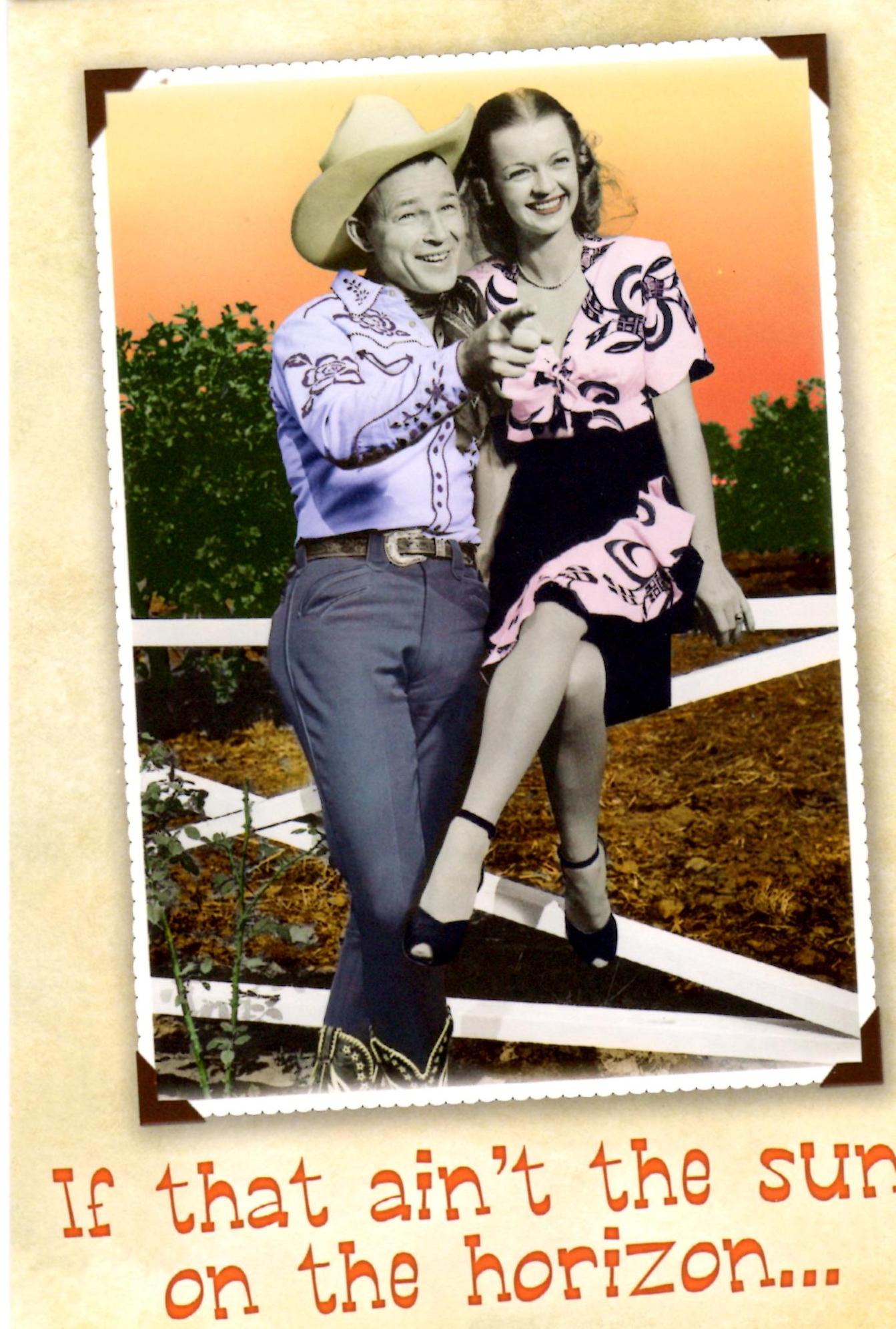
This week I celebrated another one of those birthdays. Imagine my surprise when I received a card with a picture of Roy Rogers on the envelope. I didn’t have to look at the return address to know who had sent the card. It brought a big smile to my face.

The card also had a picture of Rogers and his wife, Dale Evans, on the front, and it was signed by my cousin, “from my boyfriend, Roy and me.” It gave me a big chuckle for my day.

On the back of the card were the Roy Rogers Rider Rules. I thought I would share them with you.

1. Be neat and clean.

2. Be courteous and polite.

3. Always obey your parents.

4. Protect the weak and help them.

5. Be brave, but never take chances.

6. Study hard and learn all you can.

7. Be kind to animals and take care of them.

8. Eat all your food and never waste any.

9. Love God, and go to Sunday School regularly.

10. Always respect our flag and our country.

These rules were part of the Roy Rogers Riders Club, started in the 1940s. Any child could join by sending in his or her name and address. A Rogersgram, which looked like an official telegram, was sent  and it arrived by Trigger Express.

Trigger, for those who don’t remember the show, was Roy’s horse. I still have my card somewhere in my memory boxes.

We took these rules seriously. Our parents liked these rules because they mimicked what they told their children. Looking at these rules some 74 years later, I believe Roy’s rules should be rules everyone abides by in 2014.

Taking care of you, treating others with respect, being kind to God’s creatures and paying attention to how we live in our world by not wasting are great standards to live by.

The ones to me that the most important are: Love God, and always respect our flag and our country.

Respect doesn’t mean blindly following. Respect doesn’t mean agreement when your heart tells you to disagree on an issue. The definition of respect in the dictionary is a deep admiration for someone or something elicited by their abilities, qualities and achievements.

I have been thinking long and hard about respect  this the past week as I followed a conversation by a friend on Facebook on harassment of women in public places, such as convenience stores and fast food places, by roaming lotharios. The argument got heated when a couple of men joined in the conversation and said both sexes had problems with that.

As I read Roy Rogers Rider Rules I thought about this conversation. I have never liked “The Honeymooners” that used to be on television in the ’50s.

I did not like the comedy in the way Ralph treated Alice. Even as a child I did not like it. I did not see the humor in the disrespectful way he treated her although at my young age I didn’t realize what my dislike was for.

Fast forward to today’s comedies on television and you see someone getting sexually harassed or disrespected every day. Why is it that it is accepted behavior on television and not accepted behavior in real life? Is it any wonder those that are leering when my friend visits public places, get the idea that leering at women or even men is acceptable?

We don’t seem to have that deep respect anymore for each other and for our country. Maybe it all boils down to one thing and that is respect for one self. Our behavior, what we do and what we say, reflects our own self-respect.

If we don’t respect ourselves how can we expect respect from other people? Perhaps those that leer, berate public officials or the person in the car next to us shaking their fist, have less respect for themselves and their behavior, than the person they are directing their behavior at. If we don’t know how to respect ourselves, how can we show respect for others and how can we show respect for our country?

Deep thoughts for an old birthday gal, but that is what age is all about, wandering pondering.

Rogers believed in teaching respect. I believe Rogers had respect for himself and that is why he could show respect to others. I believe Rogers knew respect begins at home with ourselves and that is why he created Roy Rogers Rider Rules