He’s A Renaissance Man!

IMG_1420 IMG_1423 IMG_1614 IMG_1618

Larry Hodgson announced to his mother at the age of seven that he was going to be a glass blower when he grew up. Hodgson and his mother had visited Gatorland in Florida where they lived. He had watched a glass blower and had asked him, what Hodgson describes as hundreds of questions in the twenty minutes he watched.” He answered every one of them. I was so fascinated.”

His mother didn’t take his statement too seriously and according to Hodgson replied, “Yah and an astronaut and a firemen and a ballplayer. Sure you are.”

Hodgson started his career as an artist doing reverse paintings on glass. He met what is now his ex-wife at an art show and she was a glass blower. “I married into it.”

He worked with her for a few years and learned the basics, learning what you can and can’t do. “I learned the types of tools to use. Glass is pretty sensitive to what they call thermal shock. If you get things too hot, too quick it will crack. If you get things too big and you don’t keep them warm while you are working on them, they will crack. The glass we use is pyrex and it is pretty versatile. It can take pretty extreme temperature changes for the most part, so we can get away with a lot and that is why you can put that same glass in the oven and microwave and it won’t crack on you.”

After a time his ex-wife felt he was ready to tackle glass blowing on his own. “When I worked with her I was doing most of the grunt work for the first three years, doing the golding, painting the finish work, that type of stuff. It just got to the point where I was giving her technical advice while she was working she stated ‘You got it figured out, start making stuff.’ I gained a respect again because sitting down and doing it made me realize it only looks simple because you know what you are doing.”

The first piece Hodgson made was a little alien guy throwing a football. He explained the why of a little alien guy. “It didn’t come out looking anything like I was trying and it didn’t last the afternoon. It was riddled with flaws and it ended up breaking because there was so much stress in it. It made me want to understand it more because I knew I could sculpt it, but unless you do things proper through heating things the right way, they are not going to stay together. Mastering the art of glass work is a discipline you are always working on because the quicker you get with something, the less heat you are giving it, even a design you made 100 times. The quicker you do it, the more chances there are for failure.”

Hodgson and his ex-wife traveled to Minnesota from Florida every year for the Renaissance Festival in Shakopee. It got to the point that they couldn’t keep up with the demand during the week and they didn’t have a facility to make more during the fair. They settled in Minnesota Lake, as it was close enough to the fair that they could drive home and work during the week. Their studio had a storefront, but was more of a working studio. It didn’t have set hours for the public, but the locals knew if the lights were on, Renaissance Glass, the name of his business, was open.

In recent years Hodgson made the move to Wells and married Wells resident Diane Sonnek. He has moved his studio to the Northbridge Mall in Albert Lea and has set business hours. “When you are at home and look around all the things that need to be done, it is too easy to take the afternoon off. When at my studio, I am here and when I am not working that torch, I go crazy. It is a good motivator to keep me working.” Glass blowing is Hodgson’s full time career and he has spent 23 years at the Renaissance Festival and plans to continue that venue for many years into the future.

Hodgson explained his type of glasswork. “In a nutshell what I am doing here is actually referred to as glass lampwork.” Glass lampwork is a branch of glass blowing that gets the name from practices from days gone by. “In the old days they used to use an oil lamp. That was the heat source and they used to use a bellows to blow air over that flame to make it hot enough to melt the glass. People think with glass it’s always the big furnaces. We don’t use the big furnaces. We are heating up rods of glass with a torch. You can bend them and twist them into the figures.”

Most of the patterns from Hodgson’s glass creations come from his head by looking at pictures or designing his own. He described some of the challenges he has met in his work. “I like some pieces because of their end result. It looks super nice. I like other pieces because of the challenge and I also dislike those pieces for the same challenge. We had a carnival come through town in Minnesota Lake a few years back. They wanted something for the owner of the carnival. It was the 30th anniversary and this owner started out the shows with the Scrambler. They commissioned me to make a blown glass carnival ride. I’m thinking that’s a bunch of poles. I can measure them and make it happen. They let me climb all over the scrambler and I took a bunch of pictures for reference. I ended up making a blown glass scrambler that was pole for pole, a scaled replica of the Scrambler that they had been dragging around since the 50’s. This thing when it was finished was 28 inches across and 12 and ½ pounds. I gave myself a week to work on it, which I never do. I never do a week on a single piece. Seven days later I was still working on it. I was thinking ‘Oh my gosh, I bit off more than I can chew, never again.’ At the end of it, what I ended up with, was this giant blown glass Scrambler that I was really proud of, but I would never want to tackle it again.”

Hodgson’s studio has small, miniature pieces of glass made into animals, creatures and other delicate creations including necklaces and earrings. He challenges his customers to take a close look at the structure of the delicate glass pieces. If you look real close at blown glass you will notice most of the animals are just a teardrop. A teardrop of glass for the main body and then you add four legs. The tail dictates what the animal is. You must design so you always can hold on to that piece, still add detail to it and then usually any of that detail is brought out in the finish work when it is colder. Paint or gold is added and different things that bring the details to the surface.” Larger glass oil lamps with various blown glass figures also decorate the tables and walls of his store.

Hodgson uses very limited color glass as it is more expensive and a lot more temperamental to work with. The gold is put on when it is finished, then the gold is a liquid and painted on by hand. “The nice thing about the gold when you see a piece that has the gold you will know that it has been annealed” Anneal is a heat treatment that alters a material to deform under tension and stress and make it more workable. When the gold has to be fired on and it fires on at the same temperature that the glass anneals in, you know the glass has an extra process to help strengthen it.

Twenty years ago when Hodgson started in the business an 11 gram bottle of gold cost about $100. He had to call for the price, now that same bottle is over $400. Most of the glass he uses is from a company out of Colorado. It is all different size rods. There is a difference in companies and qualities and for some it is just the length of it.

Pyrex is a brand name. It is what Corning puts out and it’s actually a brand name for what is called borosilicate glass. When Hodgson started and pennies were tight, he would shop thrift stores and buy Pyrex baking dishes for pennies. The Pyrex would be put in a paper bag and busted up with a hammer. Then Hodgson would physically make rods with his torch. He explained, “In the early days, that worked great for the spun glass because you didn’t need the same kind of clarity for a solid piece. A person could get by, by doing that, but it is so much easier working with a clean polished rod that comes from a factory. If a person had to put gas in a bus to get down the road, this worked for a few extra dollars.”

There are not many people that make the statement that Larry Hodgson does about his career. “Is it the best job in the world? Absolutely! I lose such track of time working on the torch, that my wife Diane has to pull me back in. I need to say we are a perfect match. The way she plays with the children at the Renaissance Fair, my wife Diane is equally talented. they come back to see her. They ask for her. She does sales and she keeps everything easy going out there and makes sure everyone is having some fun. She has got the memory. She can remember the name of someone and the face, whereas I can’t even remember where they are from.

She can give me that little jab and tell me that is the person that got the little unicorn with the blue mane last year. We sold 300 unicorns and she can remember that. So I ask the customer. “How are you liking that unicorn?”

The Renaissance Festival is what Renaissance Glass prepares for all year long and you can understand the passion he feels for the festival when he describes his experiences with his customers that frequent his shop at the fair. “The Renaissance is a big deal for us. We work all year long to have inventory. It’s been going on now for over 40 years and people still come out to support that show in costume and raring to get that turkey leg and souvenir. It’s a different customer than what we get in the mall. I absolutely love it. It is nothing but fun. When I am not doing sales I am out hawking for the booth. You can stand out there and make fun of people, make fun of their clothes, make fun of their baldness, whatever, and they still come in the shop. I am out there with my little wooden sword and I have a five year old or a seven year old and they are going to defend their mom’s honor.”

“Everything can be fixed or repaired. Most people don’t realize that. Between kids, cats, gravity, save the pieces. Super glue doesn’t work, it says it does. What that means is that it will stick your fingers to it.

“If you have the opportunity to pursue your dream, pursue your dream. NO one’s going to be happy working in a job that they are not happy with.”

You can find Renaissance Glass at the Renaissance Fair or in the Northbridge Mall in Albert Lea, Minnesota.

Do I Wail or Whine About Empty Nest Syndrome?

Something About Nothing by Julie Seedorf published the week of June 16, 2014 in http://www.albertleatribune.com and the Courier Sentinel

Whining and wailing were the words that were the topic of a discussion recently on a Facebook page of writers. We were all listing our pet peeves about writing and the words that are over used in books.

For instance, I have a habit of writing the way I talk. I say “so” and “that” often and other words I use that do not contribute to the story and bog it down with extra words. Thank goodness for editors that — I mean, who — occasionally take me to task for adding those words.

This day the discussion centered around books where people used the word “wailed,” which means to make a mournful cry or a high-pitched noise. The other word in the discussion was whining, used in books to describe a character or what the character is saying. There are characters that whine through the entire book.

As I was taking part in this discussion I realized I have been whining quite a bit lately. I have been whining about wanting to move closer to my children who are the parents of my grandchildren. I have been whining about being closer to a coffeehouse so I do not have to drive 20 miles to have my latte and pull out my computer to write. There is something about coffeehouses that sparks the creativity in me.

I have thought that my whining was actually about living in a bigger city. After spending a busy weekend with my family, and in a bigger community, I realized that perhaps my whining was more about still suffering from empty-nest syndrome. That realization was a surprise to me since I haven’t had any children in that nest for at least 15 years.

I have settled into a routine: Watch my own television programs, hibernate in the winter and do the normal everyday things. What I have come to realize is that if I don’t have frequent contact with people younger than me, I get more set in my ways and I feel older. If I don’t physically engage in conversation with young minds, my world doesn’t expand as much. There is so much to be learned from the youth of today.

It seems that if there are no young people in my home, it is easier to not take part in the youth activities in my community. If I don’t have a connection with a young person, then even though I may go to those activities, I am still a bystander. Where there is no encouragement to take part it is easier to settle into a shuttered life.

Visiting the city I also recognize the opportunities there are for older people. You can get lost in a big city, too, but there are also senior community groups such as the one at the Chaska Community Center that are active daily, have weekly activities and trips long and short each week.

The seniors have their own part of the building and daily there is something happening for older adults to get out and socialize with others of their age and also with the younger people in and about the community center.

I like being part of a small close-knit community where neighbors help neighbors. That is the richness of living in a small town. If I walk out my door I can guarantee that no matter where I go in my community I will meet someone I know. I like the quietness of a small town and I can wallow in that quietness, perhaps too much.

So I have been whining, caught between the richness of my community, and a place where I have lived most of my life, and wanting to expand my world to try the big city and all it offers.

Family is a big part of that exploring the big city feeling for me. It is about empty-nest syndrome and missing watching my children’s plays and basketball games. I am missing the daily rush to get done with supper and get the kids where they need to be for their schedules. It is missing what I learned each day from my children. It is missing the cute stuff they say and the laughter of having a family in the house.

Those of us who have children have all went through it. I can’t imagine I am the only mom who is the age I am and still missing the daily grind with kids. Perhaps it is about remembering my youth and the family that I was surrounded by, aunts, uncles, cousins and missing that connection, too.

Do I wallow and whine and wail or do I accept where I am placed? Do I, or I should say we, the other half of the empty-nest syndrome person, spread our wings and move closer to our kids and grandkids so we can enjoy the hustle and bustle of their sports, their music, their young lives?

I have to think, like the dialogue in a book, that my whining and wailing is getting repetitive. Is it time to edit the dialogue of my life?

What You Don’t See During a Television Sports Broadcast.

imageWe live in an ever expanding world because of technology. Occasionally it is good for all generations to reach out of our rural area and look beyond what is offered in small communities for jobs and to make connections with people whose experiences are much different than ours in the rural community. Doing this occasionally offers us insight, energizes us and gives us new understanding of what is available for the younger generation leaving the rural area.

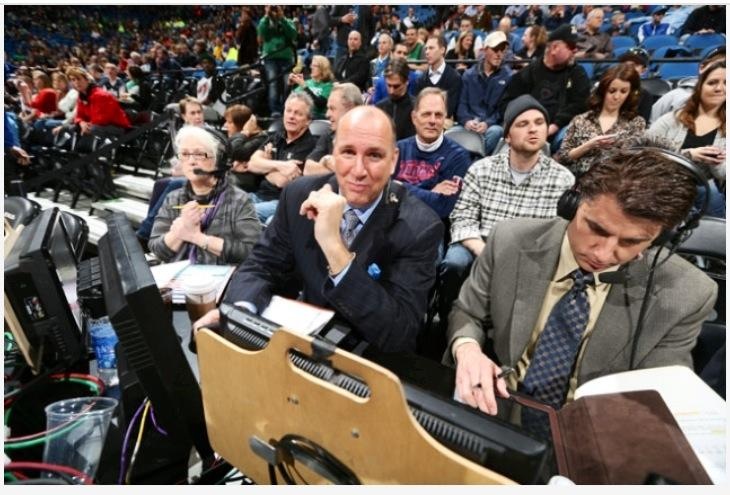
Watching sports on television is a pastime for many people on a daily basis. It is easy to sit back in our recliners and cheer on our favorite teams. We see and hear the announcers, we watch and listen to the players without a second thought as to what it takes to produce a live game. Many people behind the scenes work hard day in and day out to see that our viewing pleasure is not disrupted by glitches. Timya Owen is one of those people.

Timya Owen, lives in St. Paul, Minnesota and works as a stage manager for broadcast sports productions. This is how Owen describes her job, “My job is to facilitate communications between the producer and the broadcast booth or studio. We make sure everything is in place for the broadcast, keep the talent informed and supply them copy to read as needed. We are often called upon to run camera, adjust lighting, troubleshoot audio issues, etc. We also wrangle players for interviews and guests who might be scheduled on the set. “
Owen has been working in this field for approximately 15 years. She was working at the local PBS station in St. Paul when Minnesota got the NHL Franchise (the Minnesota Wild) and there was a need for crew to cover coinciding broadcasts. Because Owen loved sports, someone suggested she apply when there was an opening. “It was a natural fit and I’ve been doing it ever since.”
Owen is an independent contractor. There are several crewers in the area who have lists of names that call when an event requires a broadcast crew. I also get direct calls from ESPN, Big Ten Network, CBS, NBC, etc. when they need someone. Once you’re on the list, you just have to wait for the calls.”

Television viewers see a little of what goes on behind the scenes to get a game on the air. Owen expanded on that during her interview. “Viewers would be amazed at what goes into a broadcast. Some are fairly simple, but there are events that require multiple trucks and dozens of crew, several days to set up cameras and audio. In the trucks, you have producers, directors, audio guys, video tape replay guys … they are the unsung heroes. Those replays and roll-outs of highlights, all done on the fly while trying to capture a game that is still happening. I’m amazed by them. Out in the arena or stadium, there are camera guys, utilities, more audio people, sometimes makeup artists, talent, statisticians, and of course, the stage managers. Multiply it by two, because usually there’s a full crew for home and visiting teams. Add another crew if the event is also being broadcast nationally (ESPN or any national broadcaster). I haven’t even started on the in-house crew which puts the show and the crowd on the jumbotron for the folks in the stands.”
Owens hours vary from weekends to evenings. When asked about glitches that the viewer’s sometimes see or don’t see, she laughs, “Hah! Most glitches you will see or hear at home. But things only we know about….talent taking a tad too long in the restroom during a commercial break, monitors failing so that talent are describing a replay they can’t actually see, guests not showing up for interviews. I have one announcer who gets goosed by a player at every game. No names…. Lol.
Timya Owen grew up as an Air Force brat and lived all over the world, Florida, Morocco, California, Texas, Cape Cod and ended up in Minnesota. Besides her love of sports, Owen is also a writer and interested in Native American History.

She is currently working on a Cozy Mystery Series called The Fernbridge Mysteries. The mysteries take place in the Victorian Village of Ferndale in Northern California. “At this point, I’m leaning towards self-publishing, but I would love to have Cozy Cat Press accept my cozy mystery.”
When asked about her interest in Native American History she explained what sparked that interest, “I’ve been interested in native rights since the 80’s. I was active with the American Indian Movement for years through their AIM Patrol. We would patrol troubled neighborhoods in South Minneapolis in the evenings, provide security for community events, etc. I met my husband (who is Dakota from a small reservation near Red Wing) at a traditional pow wow when his dad invited us into their home for a meal. We half joke that his dad knew we were meant to be together.”
Owen offers a little advice to younger people thinking about getting into the technical part of the sports broadcast business.
“It’s really just common sense and intuition. You have to stay focused and listen to constant chatter on headsets while trying to keep your talent happy and informed. Being a people person helps, but you need to know when to back off. Every broadcast team is different. Some guys can joke around right up until air time and others need to be left alone to study game notes and player profiles. Don’t be affected by celebrity. That’s a tough one for me because I have many sports heroes.”
“Be willing to start at the bottom. Take whatever work you can get and work hard. You’ll be noticed and recommended for future jobs because the crew will know you can be counted on. Watch, listen, ask questions and be the first to admit if you don’t know how to do something. Our guys are great and they’re more than happy to share their knowledge.”
Think of Timya Owen the next time you turn on your television or computer and watch network sports. Imagine all that is going on in the background to bring you the best for your viewing pleasure. Sit back in your chair, root for your team and know that the production crew has got it covered.

timberwolves game timya timya1